Briefing 01
The Cost of Declined Bids
What doesn't appear on the P&L but still costs.
Read as text
01. The Scenario
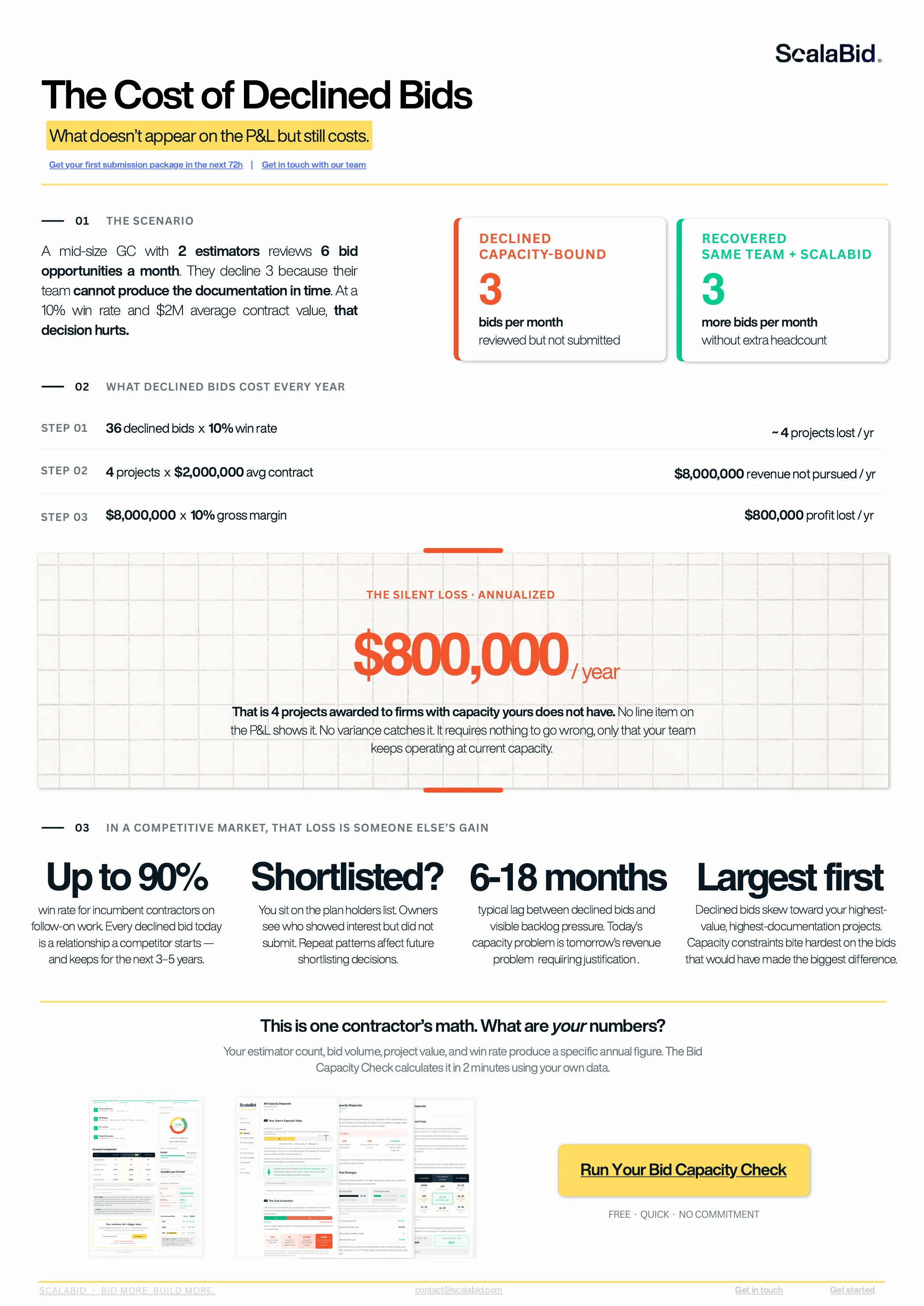
A mid-size GC with 2 estimators reviews 6 bid opportunities a month. They decline 3 because their team cannot produce the documentation in time. At a 10% win rate and $2M average contract value, that decision hurts.
Declined, capacity-bound: 3 bids per month, reviewed but not submitted.
Recovered, same team plus ScalaBid: 3 more bids per month, without extra headcount.
02. What Declined Bids Cost Every Year
Step 01: 36 declined bids times 10% win rate = approximately 4 projects lost per year.
Step 02: 4 projects times $2,000,000 average contract = $8,000,000 revenue not pursued per year.
Step 03: $8,000,000 times 10% gross margin = $800,000 profit lost per year.
The silent loss, annualized: $800,000 per year.
That is 4 projects awarded to firms with capacity yours does not have. No line item on the P&L shows it. No variance catches it. It requires nothing to go wrong, only that your team keeps operating at current capacity.
03. In a Competitive Market, That Loss Is Someone Else's Gain
Up to 90% incumbent win rate. Win rate for incumbent contractors on follow-on work. Every declined bid today is a relationship a competitor starts and keeps for the next 3 to 5 years.
Plan-holder visibility. You sit on the plan holders list. Owners see who showed interest but did not submit. Repeat patterns affect future shortlisting decisions.
6 to 18 months backlog lag.Typical lag between declined bids and visible backlog pressure. Today's capacity problem is tomorrow's revenue problem requiring justification.
Documentation skew, largest first. Declined bids skew toward your highest-value, highest-documentation projects. Capacity constraints bite hardest on the bids that would have made the biggest difference.